How to dispose of a propane tank
Last updated
What to do with a 20-pound grill tank versus a 1-pound camping canister, and which cities actually publish a drop-off or a pickup.
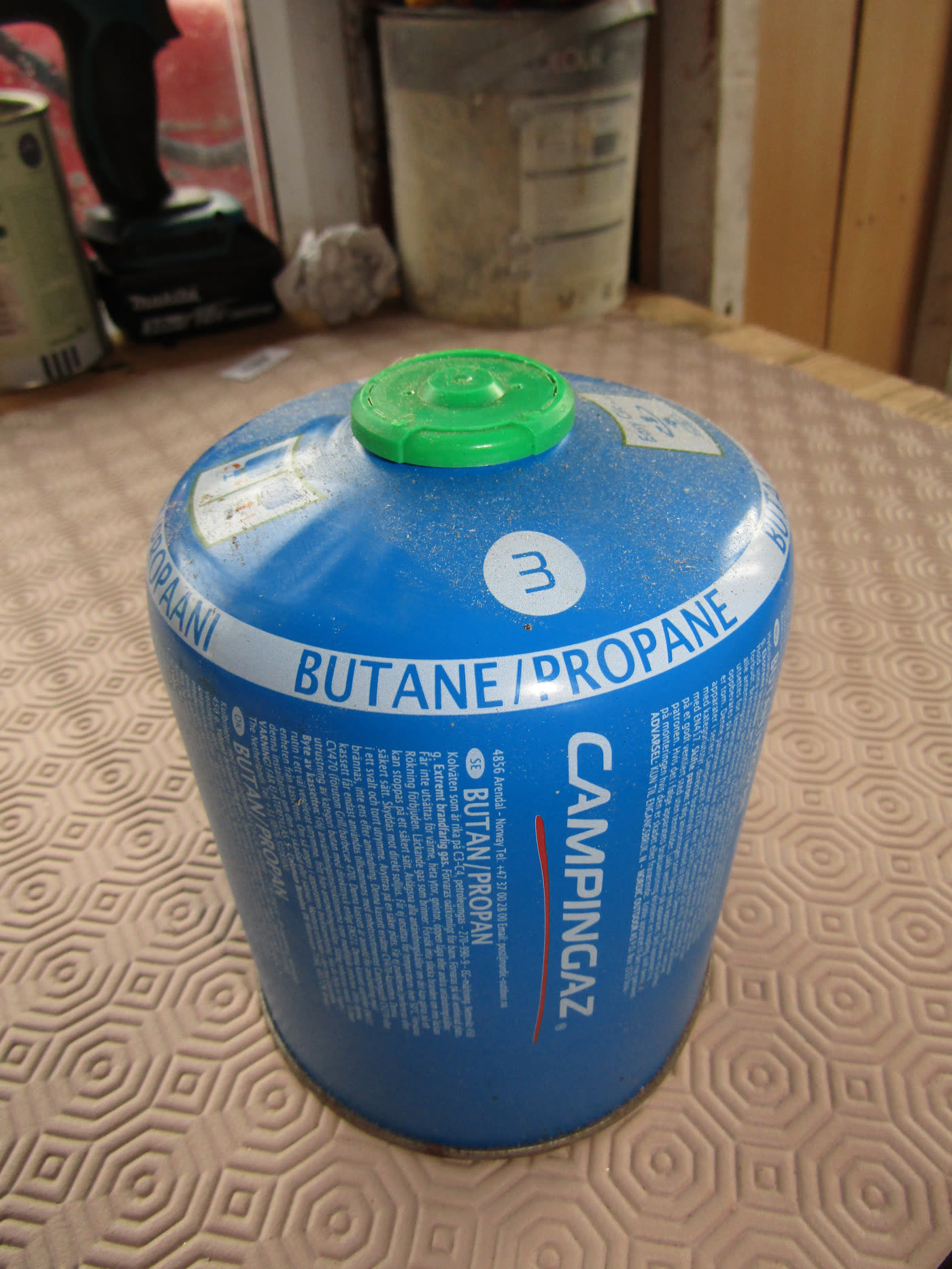
A propane cylinder is a sealed container of flammable gas. That is why it does not go in a trash cart, a recycling cart, or a compactor, and why a garbage crew that came for a sofa is allowed to leave it sitting there. The rest of the advice you see online treats every tank as the same object. They are not. A 20-pound exchange tank from a grill, a 1-pound camping canister, a helium party tank, and a 100-pound cylinder for a workshop are four different disposal problems. Cities that bother to write a rule usually write it around the size.
We did not publish a propane page for a city whose official pages never named tanks or cylinders. New York's special waste drop-off list includes paint, batteries, motor oil, and tires. It does not name propane. Minneapolis says the city will not collect pressurized tanks and tells you to check the county guide rather than promising the facility takes them. Guessing a drop-off address would have been worse than a gap. This guide sticks to rules we read.
Refill and exchange are not disposal
A 20-pound tank that still has a sound valve is often a candidate for an exchange cage or a refill, not for a hazardous waste site. That is a retail transaction. The company that owns the cage sets the rules: rust, an outdated valve, a tank that is too old, or a cylinder that is not their brand can all be a no. We are not going to pretend every Blue Rhino or hardware-store cage is a public program. If the clerk takes it, you are done, and you did not need the city. If the clerk refuses it, you are now in disposal, and the city page matters.
Do not empty a tank by opening the valve in the yard so that it "qualifies" as empty. A full tank is a product. Disposal is for the tank nobody will refill and that you cannot legally throw away. Venting it next to a house is how people start fires. We did not find a city page that tells you to bleed a cylinder in the driveway.
The one-pound canister
Camping canisters and the small cylinders under a portable stove are the ones some cities will pick up, and only when they are empty.
Seattle's special item list has a $5 pickup for up to four canisters under one pound. The test on the page is physical: it should not rattle when you shake it. A canister that rattles still has fuel and belongs at the hazardous waste facility, not on the $5 list. The same city will also take up to four of those small empty canisters inside a special item box, alongside batteries and bulbs. Community collection events take empty camping canisters too, and they do not take hazardous waste. A full cylinder is the wrong event.
Austin's hazardous waste pickup includes propane cylinders up to one pound. They ride in a labeled box on the porch, not at the curb, on an appointment, inside a 30-gallon total. A 20-pound grill tank is not on that line. Do not write "propane" on the box and hope the crew stretches a one-pound rule to a barbecue tank.
Houston's environmental service centers are more generous on size and more specific about the kind of tank. The flammable list includes propane and helium tanks of five gallons or smaller. A typical 20-pound grill cylinder falls under that description. A larger tank does not. The centers also say they do not pour gasoline for you. Gas cans have to be left behind or emptied into a sealable bucket before you arrive. Fuels are capped at 15 gallons. A propane tank and a gas can are two lines on the same page. Read both. Heavy trash day is not an option. Fuels and chemicals are banned from the curb, and a tank next to a mattress can get the pile refused.
The 20-pound tank, where a city named it
Los Angeles lists propane cylinders among the materials a S.A.F.E. center will take, with paint, solvents, aerosols, and automotive fluids. The visit cap is 15 gallons or 125 pounds of hazardous waste. You stay in the car. Staff unload. Transport the cylinder upright, valve closed, in the trunk or the bed. The centers are a weekend service. Washington Boulevard, at 2649 E. Washington Boulevard, posts Saturday and Sunday, 9 a.m. to 3 p.m. If the tank is hissing or the valve is broken, call 1-800-773-2489 before you drive it. The monthly bulky yards are the wrong door. Their flyer bans hazardous waste.
Seattle's hazardous waste facilities accept propane tanks and are free for King County residents, with no appointment. They are not the transfer stations. The city's where-to-go page has the addresses. We did not copy a street address we had not read in the source text, so use that page rather than a forum pin.
Portland's Metro hazardous waste desks accept compressed gas cylinders. Household loads are free up to 35 gallons, measured by container size. Metro Central is at 6161 NW 61st Avenue, hazardous waste hours Monday through Saturday, 9 a.m. to 4 p.m. Metro South is at 2001 Washington Street in Oregon City, 9 a.m. to 4 p.m. daily. A propane tank is not on Portland's bulky price sheet. The $10 "small item" examples are a tire, a microwave, a vacuum, and a bicycle. Do not set a cylinder out for the garbage company as if it were a microwave.
Phoenix is the strict one. The transfer station page says bulk propane and Freon containers must have valves removed before they are acceptable for disposal. That is a condition, not an invitation to attack a full tank with a wrench. If you cannot meet it safely, you do not meet it. Call 602-262-6251, describe the tank, and ask which station is taking them. The once-a-year hazardous waste box at your door is written around paint and household chemicals. The page we read does not name propane. Ask hhwcollection@phoenix.gov before you put a canister in that box. Do not assume.
San Francisco's bulky accepted list includes the word "tanks" and does not define it. The same company sends paints and chemicals to the hazardous waste facility at 501 Tunnel Avenue and says the bulky program does not take hazardous waste. A propane cylinder is a compressed flammable gas. We do not read the word tanks as permission to set one at the curb. Call the hazardous waste desk at 415-330-1405 or email hhw@recology.com and say it is propane.
What nobody should do
Do not put any cylinder in a trash cart, a dumpster, or a recycling bin. Compactors and trucks are not built to puncture a pressure vessel on purpose, and they sometimes do it anyway.
Do not puncture a canister to "make it empty." The Seattle test is a shake, not a nail. Austin and Houston want the cylinder as a cylinder, in a size they named.
Do not hide a tank in a bulky pile. In Houston, Los Angeles, Portland, and Phoenix, the bulky rules and the hazardous rules are different crews. A mixed pile is how you lose the sofa pickup too.
Do not bring a business quantity and call it household. Welding cylinders, forklift tanks, and a shed full of camp canisters from a scout troop are not what these household caps describe. Metro wants businesses to apply and pay. Los Angeles points some business hazardous waste to a separate appointment. Houston's centers ask for proof the waste is from a residence.
Do not store a leaking tank in a hot garage while you wait for a monthly event. If it is actively leaking, that is an emergency call, not a drop-off errand. Move people away from it and call the fire department or the non-emergency line your city prints. We are not going to invent a national phone number.
Helium, CO2, and fire extinguishers
Houston's flammable list puts helium tanks next to propane, five gallons or smaller, and CO2 cartridges at lecture-bottle size or smaller. A fire extinguisher under 40 pounds is on that list too. Those are Houston's lines. Another city's propane rule does not automatically cover a helium tank from a party or a kitchen fire extinguisher. Extinguishers are pressurized and often have their own retail take-back. If your city page does not mention them, ask before you add one to a propane trip.
How to move a sound tank
Valve closed. Cylinder upright. In the trunk or the truck bed, not rolling in the back seat and not in the passenger cabin if you can avoid it. Original cap on if you still have it. One or two tanks, not a pallet. If the facility has a household quantity limit, a second trip is cheaper than a refusal.
Bring identification where the facility asks for residency. Houston wants a Texas ID or a current city bill. Los Angeles asks where the waste came from. Seattle's facilities serve all of King County, not only Seattle addresses, which is wider than most city programs. Do not assume that generosity applies at a Los Angeles center.
If your city has not published a rule
Use the exchange cage first if the tank is a standard 20-pound grill cylinder in decent shape. If that fails, call the city or county household hazardous waste program and use the word propane, the size, and whether it is empty. Write down what they say. A 1-pound canister and a 20-pound tank need to be described separately, because Austin's answer for one is a yes and the answer for the other is not on the page.
Until you have that answer, the tank stays out of the cart. That is the one instruction that does not change from city to city.