How to dispose of tires
Last updated
Why passenger tires have a count limit, why the rim has to come off, and what the cities we checked will actually take.
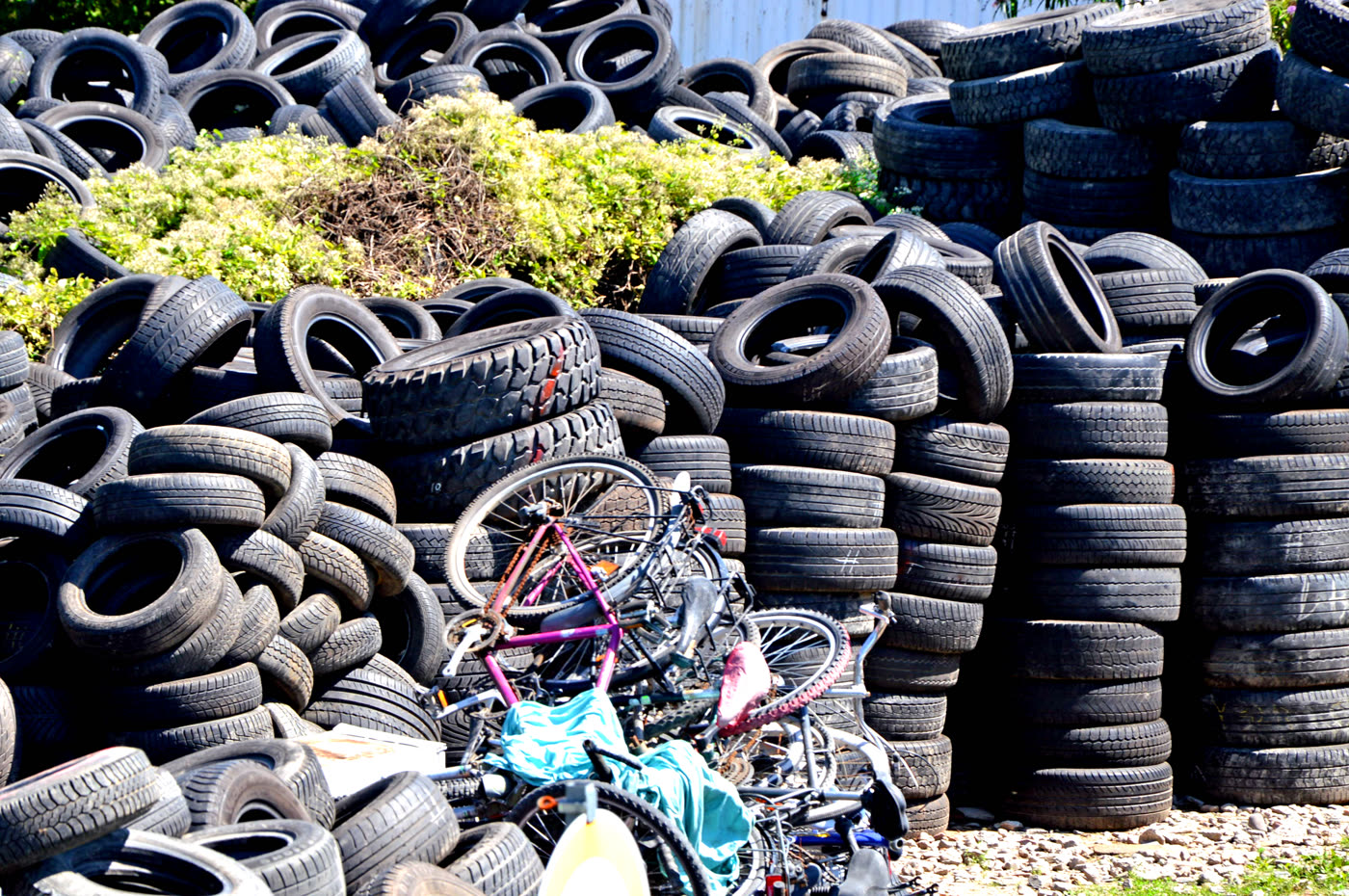
A passenger tire will not fit in a cart, and it should not be cut into pieces to force the issue. Whole tires are awkward in a landfill, they hold water when they lie on their side, and cities treat them as a counted item with a rim rule. The count is small. Four is the number you will see most often. Eight shows up in Austin. Five shows up at a Houston drop-off center. None of those numbers is a statewide law. They are the local cap.
We did not publish a tire page for a city that never mentioned tires. Seattle's special item list, which is otherwise detailed, did not name them in the pages we read. Inventing a Seattle tire fee would have been a guess. If your city is missing below, call and ask. Do not set a stack out beside the sofa and hope.
Rims off, passenger only
Almost every city that takes a household tire wants it off the rim. A mounted wheel is heavier, and it is closer to an auto part than to a clean tire. Auto parts are on a lot of do-not-collect lists, including Minneapolis and Philadelphia.
Austin takes passenger car tires, rims removed, eight per household, in their own pile on a booked bulk day. Truck and tractor tires are refused. Tires still on rims are on the not-accepted list. You get three bulk appointments a year, houses and fourplexes only.
Philadelphia takes four passenger tires per bulk appointment, rims off. Four is also the total item cap for that appointment, so four tires is the whole week. One appointment per household per week. Buildings over six units are out of the program.
New York takes up to four passenger car tires at a special waste drop-off, not on the sidewalk. Hours are Tuesday through Saturday, 9 a.m. to 3 p.m. The large-items page lists tires among the things with special rules. Truck tires are not what the line says. Ask before you unload a truck tire, or you will be putting it back in the car.
Los Angeles takes four tires off the rims at the monthly Saturday bulky yards, not on the curbside bulky list. The 2026 Saturdays are printed on the city's flyer. Bring the resident, a current LADWP bill, and a state ID. One visit that day. The curbside crew that comes for a mattress is not a tire crew.
Houston lets you set out up to four passenger tires on heavy trash day, in the even months. Crews pull them out of the pile and may take up to a week to come back for them. Leave them. The environmental service centers take five tires per residence and refuse commercial vehicle tires. Do not do both in a way that puts nine tires on one curb. The curb rule is four.
Washington, DC does not put tires on the seven-item bulk appointment. Up to four go to Fort Totten, 4900 John McCormack Road NE, and only on Wednesday, Thursday, and Friday, 10 a.m. to 2 p.m. Saturday is a bulk day for other items. It is not a tire day.
Portland lists a vehicle tire as a $10 small bulky item, plus an $18 trip fee. The hauler confirms the category and can charge more if the stop takes extra people. The table says vehicle tire. A truck tire or a mounted wheel should be described when you call. Metro's hazardous waste desk is for chemicals, not for a stack of rubber.
Where the curb is a no
San Francisco's bulky program does not take auto parts or tires. Spending one of your two free visits on a set of tires can mean the visit is refused. The transfer station at 501 Tunnel Avenue posts a surcharge of $19.36 for a passenger or light-truck tire with no rim, and $23.10 with the rim, each plus weight. A truck tire is $37.46 off the rim and $47.46 on it. Loads of ten or more are not accepted unless the hauler is a registered tire hauler with a manifest. Four tires from one car is under that line. Ten is a regulated haul.
Denver's large-item pickup names tires among the hazardous materials it will not take, alongside paint and batteries. A public-health page says waste tires are prohibited from Colorado landfills, along with lead-acid batteries, electronic waste, and liquid wastes. We are citing the city's page for that prohibition. The large-item page points you at a waste directory and does not print a tire address or a per-tire fee. We did not invent either. A shop that sells tires often takes the old ones for its own posted fee. That number is the shop's.
Minneapolis will not pick tires up. The accepted-garbage page lists them with auto parts and building materials. The department says tires can only be dropped off at the South Transfer Station, and that customers get vouchers that can cover tires. Read the voucher. We did not see a per-tire price on the pages we checked.
Phoenix bulk trash says no tires, any shape or size. The transfer station page has an "appliance and tire" heading and then spends the text on appliances and CRTs. We did not publish a Phoenix tire fee from a heading. Call 602-262-6251 before you haul them.
Why the pile in the photo is not a plan
A field of tires is a storage problem and a fire problem. It is also how mosquitoes get a permanent puddle. You do not need a national statistic to see a stack of tires holding water. One household's four tires are a city errand. A garage that changes tires for a living is a commercial load, and the household caps above do not cover it. Houston says contractor debris is not heavy trash. San Francisco requires a registered hauler and a manifest at ten tires. A "friend with a truck" and twenty tires is how people get turned around at a scale house.
Do not burn them. Do not bury them. Do not dump them on a vacant lot because the appointment calendar was full. That is the illegal dumping the bulky rules are written to prevent. If you are over the cap, it is a second month, a second week, or a shop, not a creek.
Shops and the new tire
When you buy a tire, ask the shop what they charge to take the old one, and whether the rim has to come off first. Many shops include a recycling fee in the new tire. That fee is not a coupon you can use at a city yard, and a city yard's free four is not a coupon at the shop. They are separate systems. If the shop will take the old set as part of the purchase, you are done, and you do not need the Saturday yard.
If you are only disposing of tires and not buying any, the shop may still take them for a fee, or it may not. Call. The city option, where we have one, is the counted drop-off or the counted set-out.
A household checklist
- Count the tires. Compare the count to the city's cap, not to what feels reasonable.
- Get them off the rims if the page says off the rims. Every page above that states a preference says off.
- Confirm they are passenger tires. Truck, tractor, and commercial tires are refused in Austin and at Houston's centers, and they are priced differently at San Francisco's scale.
- Do not mix them into a pile of furniture if the city collects tires separately. Houston's crews pull tires out and may come back days later. A mixed pile of allowed and banned items can be refused entirely in more than one city.
- Do not set them out on a day that is not a tire day. DC's Saturday bulk hours are the trap. Tires are Wednesday through Friday there.
- If you have more than a household set, you are in commercial territory. Say so. Pretending twenty tires are "from the house" is how loads get rejected and sometimes reported.
The tire is not mysterious. It is counted, it usually cannot wear its rim, and it does not go in the cart. The cities that publish a number are doing you a favor. Use the number.
If you are hauling them yourself, stack them so they cannot roll around the trunk, and do not mix them with a load of dirt or construction debris. Transfer stations price mixed loads as garbage. A clean set of four passenger tires is the load the household rules describe. A tire full of water should be emptied before you lift it. That water is a mosquito puddle and a soaked back seat, not a reason to leave the tire in the alley for another week. Write the count on a slip of paper if you are going to a staffed site. It sounds fussy. It also matches the way the rules are written, as a number per visit, not as "some tires." When you get home, the rims you pulled off are scrap metal if they are bare, and they are an auto part if they still have bearings and a tire. Ask before you add a dirty wheel to a metal pile the city only wanted as a tire.