How to get rid of a mattress
Last updated
What to do with a mattress when your city will not take it in the trash cart, including the four-state recycling fee, bag rules, and who is actually eligible for pickup.
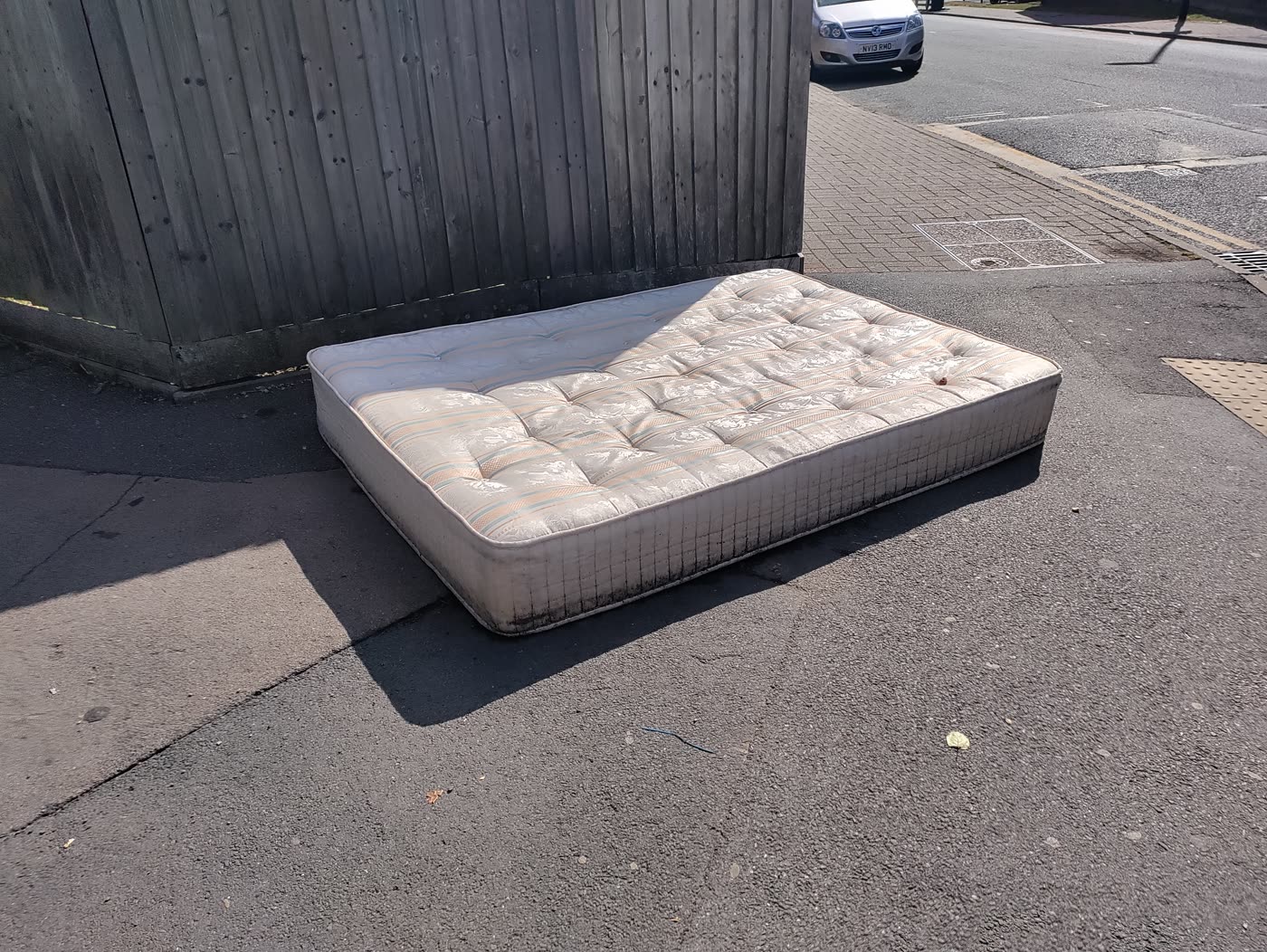
A mattress does not fit in a trash cart. That is the whole problem, and it is why so many of them end up in alleys. The steel springs, the foam, and the wood in the box spring are recyclable in a facility that is set up for them. A regular garbage truck is not that facility. Some cities send a second truck. Some charge you for it. Some tell you to drive the mattress to a gate across town and will not come to the house at all.
This guide is the background. If we have read your city's sanitation page, the city guide is the rule that matters, because a statewide program does not book the local truck. Start with the city if it is on the list. Use this page to understand the fee, the bag, and the building-size limits that show up over and over.
The only statewide mattress programs we can cite
The Mattress Recycling Council, a nonprofit set up by the mattress industry, runs consumer drop-off under the name Bye Bye Mattress. It operates in four states: California, Connecticut, Oregon, and Rhode Island. The council's program page says those four and no others. Its homepage has thrown around larger recycled-mattress counts that do not match the state-by-state numbers on the program page. We use the program page. It says the programs together have collected more than 15 million mattresses, with California over 14 million since 2016, Connecticut about 2 million since 2015, Rhode Island about 875,000 since 2016, and Oregon about 130,000 since 2025. If those figures move, the program page is the one to trust.
Each state funds the work with a fee on a new mattress or box spring. The Bye Bye Mattress FAQ lists the amounts that were current when we checked on November 20, 2026:
- California, $18.00 per unit as of January 1, 2025.
- Connecticut, $19.50 per unit as of October 1, 2026.
- Oregon, $22.50 per unit as of January 1, 2025. Oregon calls it a stewardship assessment.
- Rhode Island, $22.50 per unit as of January 1, 2026.
You pay the fee at the store even if you have no plan to recycle anything. The FAQ is clear about that. The fee is on the sale, not on the act of dropping an old mattress off. You also do not need to have paid it on the old mattress. In California and Oregon, a resident can drop off a mattress or box spring regardless of condition and regardless of when it was bought. Connecticut and Rhode Island take them when they are in recyclable condition. The program is for people in those states. A mattress that was used somewhere else is not what the sites are funded to take.
The fee does not call a truck. It pays for collection sites, transport, and taking the mattress apart. The council's program page counts more than 240 sites in California, more than 135 in Connecticut, 39 in Rhode Island, and 27 in Oregon. The locator is on byebyemattress.com. We do not copy the store list onto this site. Retailers join and leave, and a stale address is how you waste a Saturday.
What the recyclers actually pull out
Boston's mattress page, which is not an MRC state page, still gives a plain description of the materials. Foam becomes carpet padding. Fabric and fiber go into industrial uses. Steel springs are scrap. Wood from the box spring is shredded for mulch or burned as fuel. Boston says roughly three quarters of the components can be taken apart. That is Boston's figure for the process, not a promise that your rain-soaked mattress will hit 75 percent. A site can still reject a unit that is too wet, too dirty, or full of bed bugs. San Diego's participating site does exactly that.
Bag it, or do not bag it
This is where people copy a rule from the wrong city and get a ticket or a rejection.
New York City wants the mattress and the box spring sealed in plastic, set out on the trash-only day, not the recycling day. The collection-laws page says the bag should be clear and securely sealed, and it lists fines of $50, then $100, then $200. The furniture page says a fine can reach $300. Both pages are DSNY. Bag it, and do not budget for the smaller number. There is no appointment. You get six bulk items on a collection day, and a mattress plus a box spring is already two of them. If the mattress has bed bugs, 311 also wants a sign that says so, so nobody carries it home. The sign does not replace the bag.
Philadelphia is similar and also different. The bulk appointment will not take a mattress. A mattress wrapped in plastic goes out with regular trash, as one of up to two large items that day. An unwrapped mattress is not eligible and the city says it is subject to fines. The page does not print the dollar amount. Wrap it anyway.
Denver collects large items every nine weeks and says mattresses and box springs must be bagged and wrapped. They count toward five large items. Setting one out on any other week is what the city calls illegal dumping.
Washington, DC requires the wrap too, and you need a 311 appointment first. The cap is seven items. Only houses and buildings with three or fewer units are on DPW's bulk service.
San Diego is the reverse. The Miramar collection site refuses a mattress or box spring that is in a plastic bag or a cardboard box. Staff have to see that it is not severely damaged, wet, twisted, frozen, soiled, or infested. A bag hides the problem, so the bag is banned. Hours are weekdays, 7 a.m. to 3 p.m., on the east side of the landfill entrance at 5161 Convoy Street. There is no curbside pickup. The city's FAQ says so in plain language.
Los Angeles lists mattresses and box springs as free bulky items and does not publish a bag rule on the scheduling page. Do not import New York's bag onto an LA set-out unless the scheduler asks for one. Do schedule it, at least one business day before your trash day. The pickup is not automatic.
If you remember one thing, remember that the bag is a local rule. It is not a universal hygiene tip.
Who the city will actually visit
Building size knocks a lot of people out, and the cutoffs are not the same.
San Francisco, through Recology, gives buildings with five or fewer units two free bulky collections a year. A unit in a building with six or more gets one. Ten items per visit. You put a sign on the pile that says RECOLOGY. Mattresses and foundations are on the accepted list, and you can also drop one at 501 Tunnel Avenue.
Boston says it collects from most buildings with six units or fewer, and that larger buildings have to use the property manager. The same page sometimes says seven or more. If the address will not book, use the form on Boston's mattress page or call 311 at 617-635-4500. The cap is ten mattress items a year. Past that, Boston tells you to hire a private hauler.
Houston collects mattresses as heavy trash in even months only, for addresses on city service, which stops at buildings of more than eight units. There is no special mattress appointment. You use the heavy-trash week and an eight-cubic-yard pile limit.
Austin's published bulk list says furniture and does not print the word mattress. The scheduler in the Austin Recycles app is the check. Buildings with five or more units are on a private hauler anyway.
Minneapolis takes mattresses on recycling week, not garbage day, with a note that says For Solid Waste, and only two large items that week. Keep it dry. The city says mattresses are disassembled for recycling. Minnesota is not an MRC state, so this is the city's own program, not Bye Bye Mattress.
Seattle charges $31, billed to the utility account holder, and limits the item to 300 pounds, 8 feet high, and 4 feet in diameter. A mattress and a box spring are two charges if both go. Washington is not an MRC state.
Portland's city rate sheet puts a king with the box spring in a $29 example, a queen or full at $21, a twin at $14, plus an $18 trip fee. Or you drive up to four units a day to Metro Central at 6161 NW 61st Avenue, free. Futons, crib mattresses, sofa beds, waterbeds, and air mattresses are charged as garbage there. Oregon is an MRC state, so the $22.50 fee and the Metro drop-off are both real, and they are not the same thing.
What is not a mattress
Programs and cities keep a second list, and it is easy to ignore when you are staring at a pile of bedding.
Bye Bye Mattress and San Diego's site refuse, in various combinations, futons that will not leave the frame, crib and juvenile mattresses, sofa beds, waterbeds, air mattresses, car beds, toppers, pads, pillows, and sheets. Boston will not take futons or toppers on the mattress appointment. Those can go out as ordinary trash in Boston. A topper is not a mattress just because it was on one.
If the item is a sofa bed, pull the metal frame out where the city recycles metal, and deal with the mattress part under the mattress rule. New York says this about sofa beds specifically. Other cities may want the whole piece left intact. Philadelphia says metal-frame furniture should stay in one piece for the bulk crew. Read the local line before you take a sofa apart in the living room and discover you have created building debris nobody will touch. Minneapolis will tag broken-down furniture as building material and leave it.
Bed bugs, rain, and the honest condition problem
A clean mattress can be donated. A stained one should not be. Los Angeles says this on the bulky page before it explains the free pickup. Boston says a soiled mattress or one with bed bugs has to be fully bagged or the crew can skip it, and suggests bagging in bad weather even when the mattress is clean so it can still be recycled. Minneapolis asks you to keep the mattress dry for the same reason. San Diego will not take the infested or soaked one into the free recycling stream at all. Those become trash, and trash at a landfill can mean a fee.
Do not put a bug-infested mattress on the curb unwrapped in a city that requires a bag or a sign. You are handing the infestation to the next tenant who thinks they found something free. New York's sign rule exists for that.
Do not cut a mattress into strips to force it into a cart. Boston forbids crushing or cutting a mattress that is supposed to be collected intact. Other cities do not always print the sentence. A deconstructed mattress is springs and foam on the sidewalk, which is worse than the original object, and it can be tagged as construction debris.
If the store is delivering a new one
Ask the delivery crew, before they leave, whether they take the old mattress. Boston puts that question on its mattress page. Many retailers do it because they are already at the door, and in the four MRC states they are often part of the recycling system already. It is not automatic. If you do not ask, they will leave the old one in the hall. Get the answer in writing on the order if you can. A verbal yes from a salesperson and a no from the driver is a common way to end up with two mattresses.
If your city is not on this site
We publish a city only after reading its sanitation page. A missing city is not permission to use the cart, and it is not permission to copy the nearest big city. Call the public works department, or 311 where that exists, and ask two questions: do you pick up mattresses, and do they have to be bagged. If the answer is no, ask where the drop-off is and what condition they require. Write down the name of the person or the page. Rules change, and a forum post from 2019 is how mattresses end up in creek beds.
If you are in California, Connecticut, Oregon, or Rhode Island, you at least have the Bye Bye Mattress locator even when we have not written your city. The fee you paid, or the next buyer will pay, is what keeps those sites open. Everywhere else, there is no national fallback. A junk-removal company will take it. That is a private transaction with a price you should get before they arrive, and it is not a city service. We do not rank those companies here.
A short checklist
- Look up your city on this site. If it is here, follow that page, not this one, where they disagree.
- If you are buying a new mattress, ask the seller to take the old one.
- Check the building-size cutoff before you book anything.
- Find out whether the mattress must be bagged, must not be bagged, or is not mentioned.
- Keep it dry. Do not donate it if it is soiled or infested.
- Do not set it out on the wrong week. In Denver that is illegal dumping. In Houston the heavy-trash months are only the even ones.
- A box spring is usually a second item, and it often has its own wrap rule.
The mattress in the alley is almost always someone who did not know which of those steps their city required. The steps are short. They are just not the same on the next block over the city line.