How to recycle electronics
Last updated
Why a television is not ordinary trash, which cities ban it from the landfill, and what to do with the battery before the device leaves the house.
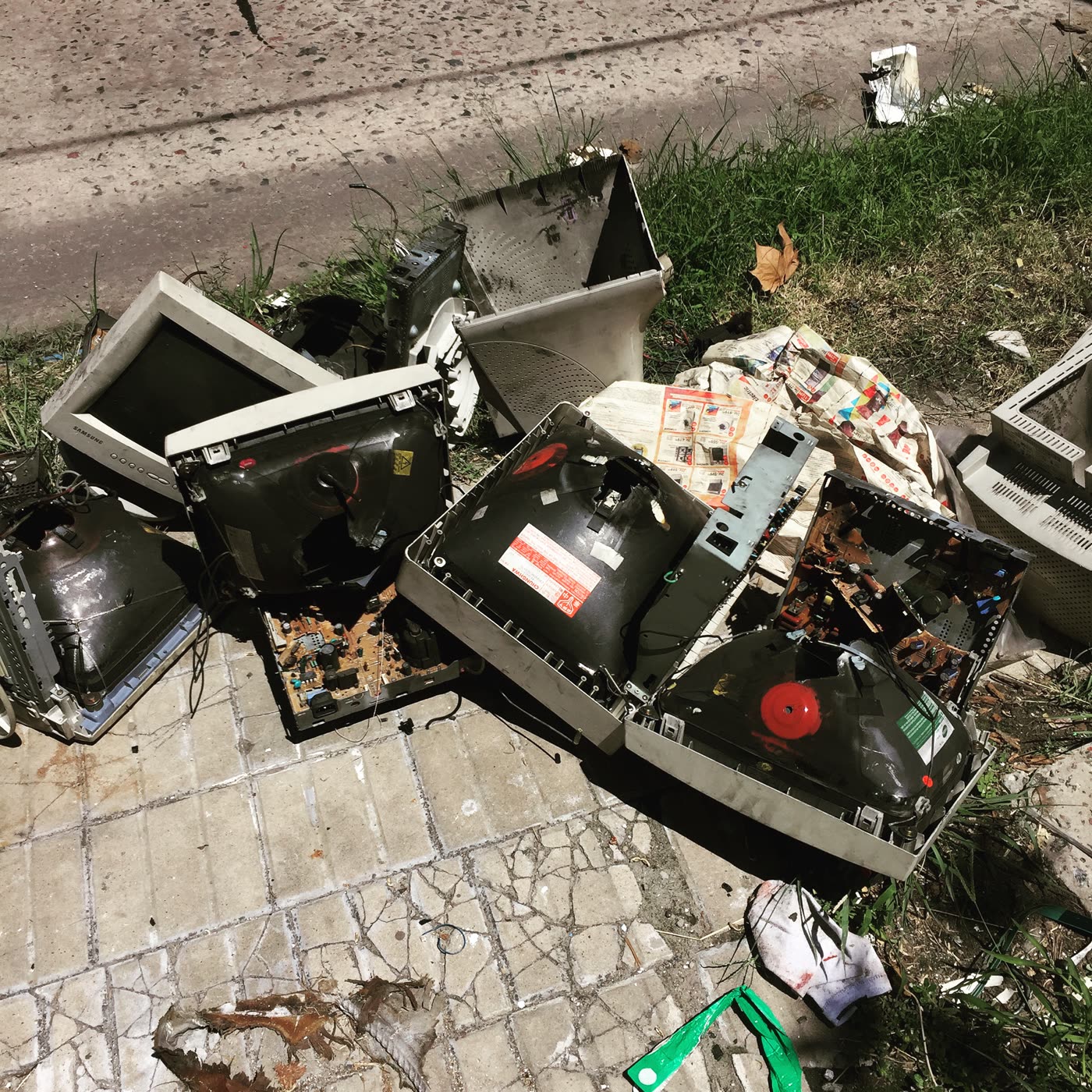
A television and a laptop are not furniture, even when they are the largest thing in the room. They hold lead, mercury, and a list of other metals Denver's electronics page spells out, and they hold your logins. Cities that care about the first problem ban them from the cart. Cities that have not written a ban still often refuse them on bulky day or charge a separate fee. The EPA's electronics page is the national background: donate what still works, recycle what does not, and do not treat a dead screen as ordinary garbage. The local page decides the door.
What "banned" actually means
Colorado's rule is the clearest one we found on a city site. Denver says disposing of listed electronics in the trash has been illegal statewide since July 1, 2013, under the Electronic Recycling Jobs Act, Senate Bill 12-133. The devices named on Denver's page include televisions, CPUs, monitors, peripherals, printers, fax machines, laptops, tablets, DVD players, VCRs, radios, stereos, game consoles, and screens larger than four inches. Large-item pickup, which runs every nine weeks, repeats the ban in fewer words. The city's substitute is an e-cycle coupon you request online. It is a discount at a recycler, not a claim that every drop-off is free. Air conditioners, refrigerators, fluorescent bulbs, and pressurized canisters are on the coupon's not-accepted list. Those have other pages.
New York City's list is just as specific and is a city rule, not a coupon. 311 says TVs, monitors, computers, laptops, printers, tablets, game consoles, cable boxes, mice, and keyboards cannot go in the trash. DSNY takes them at special waste sites, Tuesday through Saturday, 9 a.m. to 3 p.m., in all five boroughs, residents only. Cords that came with the device go with it. A television is not one of the six curbside bulk items.
Other states in this directory do not all have a sentence that strong on the city page we read. Do not assume a Texas or Pennsylvania landfill ban from a Colorado statute. Follow the city.
Pickup, drop-off, or a fee
Los Angeles will pick up TVs, computers, and monitors as bulky items if you schedule them at least one business day ahead, and it will also take e-waste at a S.A.F.E. center. The Saturday bulky yard is the exception. Its flyer bans electronic waste and anything with a plug. A TV that is legal at the curb can be refused at the yard. Use the appointment or the center.
Seattle prices a TV larger than about two feet on a side at $31, with the furniture and appliances, inside a 300-pound limit. Smaller electronics can go in the special item box, one free box a year and $20 after that. The hazardous waste facilities explicitly do not take computers, laptops, TVs, or VCRs. Bringing a television to the paint facility wastes the trip.
San Francisco lists electronics as bulky items, inside the ten-item, limited free visits Recology allows. At the Tunnel Avenue transfer station, the rate table we checked posted no charge for TVs, monitors, laptops, and small corded devices. Commercial equipment was $74.93 each. A household set is not an office pallet.
Minneapolis picks up TVs, computers, and monitors on recycling week, with a note that says For Solid Waste, as one of two large items. Crews sticker them and come back the next business day. The department says the electronics are trucked out for recycling.
Austin puts electronics in the metal and rigid-plastic pile on a bulk appointment, up to three times a year. The app has to list the item. If it will not, do not set the TV out.
Houston bans electronics from heavy trash and from the garbage cart. The environmental service centers take them. The page says not to dismantle them, and it describes a combined limit of about five large items, with a note that TVs are limited around 30 inches. The wording is cramped. If your set is larger, call before you load it. Monthly Saturday events are also listed at Kingwood and near Ellington. Confirm the month. Event flyers go stale.
Philadelphia's bulk appointment takes flat-screen TVs and does not say tube TVs. Computers are refused at hazardous waste events and directed to a sanitation convenience center. A flat screen uses one of four bulk slots and needs the pickup code taped to it.
Boston books televisions, and it lists laptops in the same section as cathode-ray tubes. Wipe the computer. The device has to be freestanding, not in a box. Five items per appointment, ten per year, and no collection without the appointment.
Phoenix lets residents bring two CRT televisions a month to a transfer station at no charge. After that the fee is $20 per CRT, plus tonnage of $55 a ton with a $40 minimum. Businesses and nonprofits cannot use the free CRT line. Non-CRT sets are on the appliance page's acceptable list. Say what you have at the scale so a flat screen is not billed as a tube.
Portland charges $6 for a TV, computer, or printer on the bulky sheet, plus an $18 trip fee, and points to E-Cycle Oregon for a free drop-off. Metro transfer stations take electronics with a limit of seven items a day per person.
Batteries come out first
A device and its battery are often two waste streams. EPA's lithium-ion page is the reason: damaged or shorted lithium cells are a fire risk in trucks and warehouses. New York tells you to bag batteries individually or cover the terminals with clear tape, not opaque tape. Alkaline cells, in New York, may go in the trash and should not be taped. Rechargeables are the ones to isolate. Seattle wants the ends taped and will not take e-bike or car batteries in the household battery bag. Austin's hazardous waste list allows lithium-ion batteries from laptops and handheld devices, not a vague "all batteries." An e-bike pack is a question, not an assumption.
Pull the pack if it comes out. Tape the terminals so they cannot touch each other or a piece of metal in the box. Do not toss a swollen pouch in the regular garbage. If the battery is punctured, smoking, or hot, that is a fire problem. Get it outside on a non-combustible surface, away from the house, and call the fire department if it is already off-gassing. Do not carry a smoking battery into a recycling event.
Wipe what still turns on
Boston prints the instruction: wipe the data before the computer goes to the curb. Other cities haul the device and do not offer a forensic wipe. Sign out of accounts, remove SD cards, and reset the phone or laptop if it still boots. A dead CRT has nothing to erase. A laptop that boots has your mail on it. The reset is your job. A sticker that says "wiped" is not a substitute for actually doing it, but it tells the next person you tried.
Donation versus recycling
If the television or computer works, a school, a reuse store, or a family member is a better end than a shredder. The EPA page says as much. Working does not mean "turns on and the screen is pink." A reuse store can refuse a stained, cracked, or obsolete set, and then you are back to recycling. Do not leave a "free" TV on the curb in a city that bans e-waste set-outs. In New York that is not generosity. It is an illegal set-out. In Denver it is the same problem on a different statute.
What this guide will not do
It will not list every Best Buy or Staples counter in the country. Retail take-back changes, and a store that took tubes in 2019 may not take them now. Call. It will not invent a state e-waste law for a state whose city page did not cite one. Texas and Pennsylvania may have rules we did not read at the statute level. The city pages we did read are enough to keep a television out of the cart in Houston, Austin, Philadelphia, and the others above.
If your city is not in our directory, search the sanitation site for "electronic waste" or "TVs," not for "trash." The answer is almost never the weekly cart, and it is almost never the same fee as a sofa.
Cables and accessories are the leftover that fills a box after the television is gone. New York wants the cords that came with the device to travel with it to the special waste site. Houston says not to dismantle equipment before the environmental service center, which means you should not strip a computer for parts on the garage floor and then arrive with a bare circuit board and a story. A keyboard, a mouse, and a printer are on several accepted lists, including Portland's Metro sheet and Denver's coupon list. A bag of mystery chargers is still e-waste. It is also a fire risk if a lithium pack is hiding in the tangle. Spread the bag out at home, pull any battery, tape it, and pack the rest so the attendant can see what you brought. Five minutes of sorting is the difference between a smooth drop-off and a refusal at the head of the line.