What to expect at a household hazardous waste day
Last updated
How permanent drop-off sites, appointment pickups, and one-day events differ, and what to pack so the staff can take the box.
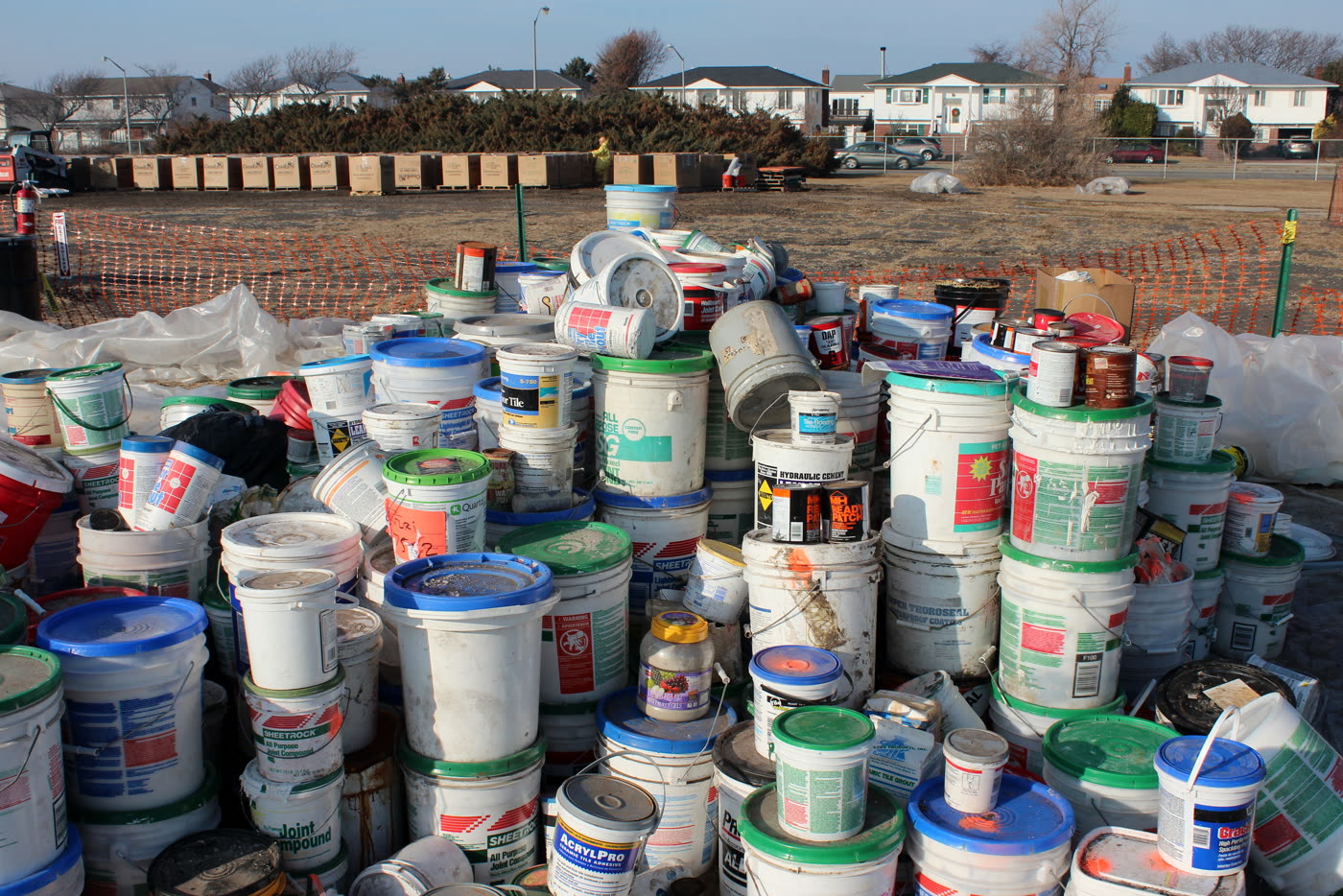
Household hazardous waste is the shelf in the garage that would be a bad idea in a trash truck. Paint thinner, pesticides, pool chemicals, solvents, mercury thermometers, some batteries, and propane show up on these lists. The EPA's household hazardous waste page is the plain version: these products can be toxic, flammable, corrosive, or reactive, and they do not belong in the cart, the sink, or the storm drain. Cities then invent the actual appointment. Some run a building that is open every weekend. Some come to your porch once a year. Some hold a Saturday event and publish the dates in March.
The photo on this guide is from an EPA collection, materials sorted before anyone loads a truck. That sorting is the whole visit. If you arrive with a mystery sludge in a milk jug, you have made their job harder, and they can refuse it.
Three ways the service shows up
A permanent site is the least dramatic. Los Angeles runs S.A.F.E. centers most weekends. You stay in the car. Staff unload. The cap is 15 gallons or 125 pounds. They ask where the waste came from. San Francisco's facility at 501 Tunnel Avenue is Thursday through Saturday, 8 a.m. to 4 p.m., residents only, with a posted chemical limit that does not match the five-gallon number on the hardware-store list. Use the limit for the door you are using. Seattle describes two facilities, free for all King County residents, no appointment, separate from the transfer stations. Metro in Portland takes households free up to 35 gallons by container size, at Metro Central and Metro South, and wants businesses to apply and pay.
An at-your-door service never puts the chemicals at the curb. Austin's box stays on the porch or in the garage, labeled, containers under five gallons, 30 gallons total, pets inside. Phoenix's box is labeled HHW and sits by the door, not the sidewalk, out by 7 a.m. for a window that runs to 5 p.m., once a year. Denver's version is one kit a year, a clear bag that holds about 10 to 12 containers, and a $15 co-pay. You set it out by 7 a.m. The instructions say to keep paint out of the bag if you need the space, because paint has its own free drop-off. Schedule Denver at 1-800-449-7587 or wmatyourdoor.com.
An event is a date and a parking lot. Philadelphia announced seven for 2026, 9 a.m. to 3 p.m., no registration. The last one was November 7 at 3901 N. Delaware Avenue. Checked on November 20, 2026, that list is finished. Do not treat a spring press release as a standing schedule. Los Angeles also runs mobile events in neighborhoods without a center. Those dates are on the sanitation site, not a weekly hour. Houston's environmental service centers are closer to permanent, with the north site only on the second Thursday. That is easy to miss if you drive there on a Wednesday.
What they usually take
Labels that say danger, warning, caution, poison, flammable, or corrosive are the field guide San Diego prints, and it matches the EPA idea. Paints and solvents, pesticides, pool chemicals, automotive fluids, aerosols, fluorescent bulbs, mercury devices, and some fuels show up on almost every accepted list we read. Propane shows up on some and not others. Austin stops at one-pound cylinders. Houston takes propane tanks of five gallons or smaller. Los Angeles names propane cylinders and does not print a size. New York's special waste list does not name propane at all.
Quantity limits are part of the acceptance. Five gallons is a common retail or event number for paint. Fifteen gallons or 125 pounds is Los Angeles and also the ceiling at San Diego's Miramar facility, which separately suggests you transport no more than five gallons or 50 pounds at a time without calling. Austin's 30 gallons is the appointment, not a single jug. Metro's 35 gallons is measured by container size, and they prefer containers under five gallons. Houston allows 100 pounds of chemicals plus 25 gallons of paint. Denver's bag is about a dozen containers, and extra material is an extra fee you arrange by phone before the day.
What they usually refuse
Explosives, ammunition in any serious quantity, radioactive waste, and medical sharps are the usual no. Metro will take some ammunition under half an inch and some sharps in a proper container, which is more than most cities. Do not generalize Metro's list to Los Angeles. Asbestos is refused often enough that you should assume no until a page says yes. Denver says no to asbestos, explosives, ammunition, commercial quantities, and needles. Business waste is refused or billed. A contractor van is not a household.
Electronics are inconsistent. Los Angeles S.A.F.E. centers take e-waste. Seattle's hazardous waste sites refuse computers and TVs. Philadelphia's events refuse computers and send you to a convenience center. Do not put a television in the paint box unless the page says the same crew takes both.
Latex paint is the other trap. Seattle refuses it at the hazardous waste facility. PaintCare states send it to a store. Philadelphia says dried latex can go in the trash. If you only remember one exception, remember Seattle.
How to pack the car
Leave products in the original container. Do not mix a pesticide with a paint. Do not pour old gasoline into an unmarked jug and hope the attendant trusts you. San Diego wants fuels in a container you can leave behind. Houston will not pour gas for you. The can stays, or you transfer it into a lidded bucket before you arrive.
Close lids. Bag a container that will not seal. Keep the box upright, in the trunk or the truck bed, not in the cabin if you can help it. Wedged between children is how a spill becomes an emergency on the freeway. Philadelphia's service page says wrap breakables in newspaper and put the box where it cannot slide.
Bring proof of residency when the page asks. A driver license, a utility bill, or both. Houston is specific. San Diego is specific. Los Angeles asks for the address the waste came from. If you are helping a parent, the waste usually has to be from a household the facility serves, not from your house two counties away. Hennepin County's drop-off is unusually explicit about which counties are in and which are out. Read that kind of paragraph. It is the difference between a successful visit and a turnaround.
Stay in the car if they tell you to. Los Angeles, San Diego, and Hennepin all say some version of this. Staff are trained. You are not unloading solvents next to a line of cars because you want to be helpful. If the site is self-serve, New York says so, and it suggests gloves and clothes you can ruin.
The day of, and the day it is cancelled
Weather closes these sites. Los Angeles says so. New York closes special waste sites in severe weather. A holiday closure is printed and then people forget. San Diego's hazardous waste calendar, when we checked, included November 28, 2026, December 26, 2026, and January 2, 2027, on top of the usual Wednesday and Saturday hours. Metro closes Thanksgiving, Christmas, and New Year's. San Francisco closes those plus the Fourth of July, the Friday after Thanksgiving, and December 26.
If you miss the event, you wait. You do not set the box at the curb the next morning. Austin, Phoenix, and Denver designed their pickup so the chemicals never sit at the curb, because the curb is where children, pets, and rain are. A leftover box of pesticides on a sidewalk is worse than the full garage shelf you started with.
Businesses and the one-time cleanout
A household cleanout of a dead relative's garage can blow past every cap on this page. That does not make it commercial, and it does not make it acceptable in one trip. Split it. Use a second appointment. Call the facility if you are over the transport limit. San Diego asks you to call about loads over 50 pounds, containers over five gallons, leaks, and unknown chemicals, and it mentions help for elderly residents who cannot drive. San Francisco will schedule a home collection by email to hhw@recology.com, you have to be home, and unlabeled waste is not picked up. Say it is unlabeled when you write, so they can tell you what to do instead of skipping the stop.
A business, even a one-person shop, is usually a different permit. Metro, Los Angeles, and Houston all draw that line. The fee a business pays is the cost of doing it legally. Borrowing a household event is how small shops get turned away in the parking lot, in front of their neighbors.
The visit is boring when you do it right. Labeled cans, a closed box, the right day, and a staff person who already knows the drill. That is the point of the program. The alternative is a can of thinner in a compactor, which is how collection workers get hurt, and it is the reason these slightly inconvenient Saturdays exist.